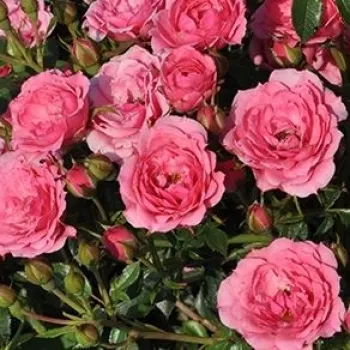
ASTERIA™ – pink dwarf mini rose - Tanjga
Imagine returning from a bracing beach walk to enjoy tea behind a gentle rose windbreak, where low, compact bushes of ASTERIA™ scatter clusters of pink blooms above glossy foliage, creating a refreshing, seaside-veranda oasis. This dwarf mini rose is naturally compact, so it slots easily into small coastal gardens, shingle beds and balcony pots, yet forms a dense, bushy edging that helps stabilise light, free-draining soil while coping well with breezy, salt-tinged air and typical coastal showers. In a 40–50 litre container it anchors securely and is simple to look after, needing only modest pruning and occasional plant protection, ideal for beginners wanting long, season-spanning colour. As an own-root plant it builds strength steadily – roots in the first year, fuller shoots in the second, then its complete ornamental presence by the third – giving you a long-lived, reliable feature with minimal fuss.
Usage options
| Target area | Reasoning |
|---|
| Coastal veranda containers (40–50 L) |
The naturally compact habit stays neat in a generous 40–50 litre pot, where its dense root system helps stabilise compost in windy, exposed spots. Moderate care needs suit those who water regularly but lack time for complex rose pruning, particularly beginners. |
| Small family garden borders |
With a mature height of only 20–30 cm, this miniature shrub slots easily into narrow beds along paths or patios, bringing soft pink colour without blocking light or views. Its bushy outline reads as a low, friendly hedge for everyday homeowners. |
| Shingle and coastal-style planting |
The low, spreading form sits comfortably among gravel, shingle and sea-themed planting, where its glossy dark foliage contrasts with pale stones and driftwood. It copes reassuringly with frequent coastal breezes and passing showers valued by coastal-style gardeners. |
| Balcony and roof-garden layouts |
The dwarf size keeps it proportionate to railings and parapets, while repeat flowering ensures colour through the season in limited space. A single large container or trough gives enough root room for lasting impact, ideal for time-poor urban residents. |
| Edging for paths and seating areas |
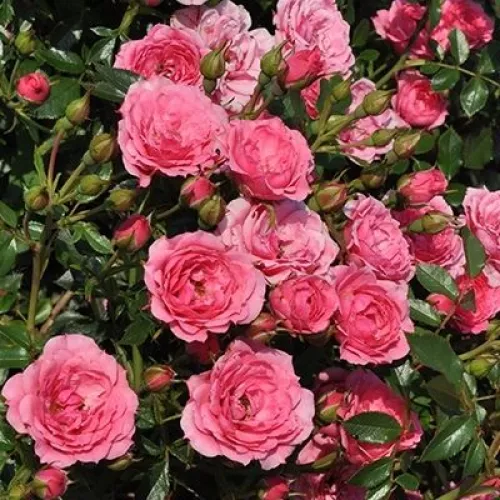
Regular clusters of small, double, cup-shaped blooms form a soft pink ribbon that outlines seating nooks or family paths without intrusive thorns. The uniform 35–45 cm spread allows predictable spacing, simplifying layout decisions for casual planners. |
| Ground-cover group plantings |
Planted at the recommended density, its compact, bushy habit knits into a low carpet of foliage and flowers that helps visually tidy awkward corners. Own-root vigour supports gradual thickening over time, rewarding patient, non-expert gardeners. |
| Children’s and “girly” play corners |
The soft mid-pink, velvety blooms and small scale feel friendly and approachable, creating a gentle, storybook atmosphere beside playhouses or shell collections. The very faint fragrance avoids overpowering enclosed spaces, appreciated by sensitive families. |
| Urban public and shared spaces |
Its uniform height, moderate disease resistance and repeat blooming suit low-maintenance blocks in front gardens or communal beds, where regular but simple care is realistic. Own-root construction supports a long service life, reassuring budget-conscious managers. |
Styling ideas
- Seaside-border ribbon – Plant a curving line of ASTERIA™ along a shingle path, pairing with blue Festuca and sea kale for a soft coastal feel – for coastal-style enthusiasts.
- Veranda tea corner – Use a single 50 L pot near seating, underplanted with trailing thyme and chives for scent underfoot – for balcony and veranda owners.
- Pink-shell patch – Group several plants in a gravel bed dotted with seashells and white Lychnis for a “girly” seaside vignette – for families with young children.
- Mini hedge frame – Space plants at 25–30 cm to frame a small lawn or sandpit, combining with low lavender for year-round structure – for hobby gardeners.
- Urban roof pocket – Position ASTERIA™ in a large trough with Bupleurum and ornamental grasses, keeping height low but colour constant – for busy urban residents.
Technical cultivar profile
| Parameter | Data |
|---|
| Name and registration |
Miniature dwarf rose from the Pixie® collection; registered as BOZastepix, marketed as Asteria™ Pixie® BOZastepix, a compact decorative shrub suited to pots and edging roles. |
| Origin and breeding |
Bred by Biljana Božanić Tanjga for PhenoGeno Roses (Serbia/Netherlands); registered in 2019 and introduced in 2020 as a modern dwarf garden and container miniature. |
| Growth and structural characteristics |
Compact, bushy plant 20–30 cm high and 35–45 cm wide, with dense, glossy dark green foliage and moderate prickles, forming a low, rounded shrub for tight planting schemes. |
| Flower morphology |
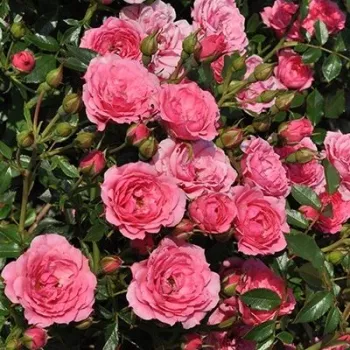
Small, double, cup-shaped blooms in clusters, 26–39 petals, repeating well with a generous second flush; designed to give a fine-textured, floriferous effect over the season. |
| Colour data and phenology |
An even, velvety mid-pink that opens from vivid buds, gently lightening to powder pink and paler edges in strong sun, retaining a harmonious overall tone as flowers age. |
| Fragrance and aroma |
Very faint, delicately sweet aroma, usually only noticeable at close range; primarily chosen for visual impact rather than scent-driven planting or fragrance collections. |
| Hip characteristics |
Occasional small, spherical hips around 5–7 mm, orange-red when mature, adding discreet seasonal interest but not a dominant ornamental feature or wildlife food source. |
| Resistance and winter hardiness |
Hardy to around –23 to –21 °C (RHS H7, USDA 6a), with moderate resistance to powdery mildew, black spot and rust, benefiting from standard preventive care in damp seasons. |
| Horticultural recommendations |
Prefers a sunny site with well-drained soil or quality potting mix; suit 40–50 L containers, balcony, roof, edging and ground-cover uses, with medium maintenance and basic protection. |
ASTERIA™ – pink dwarf mini rose - Tanjga offers compact long-season colour, easy container use in small spaces and the durable, regenerating advantages of an own-root rose, making it a thoughtful choice for relaxed coastal or urban gardens.